Nordic Defence and Security Confrence 2026
Financing Nordic Defence Readiness
Speed set the agenda at the Nordic Defence and Security Conference
Around 800 participants from the armed forces, government, research and industry gathered at the Nordic Defence and Security Conference 2026 in Stjørdal, Norway. Danske Bank was one of three main partners. One theme came up again and again on stage: speed.
The Nordic Defence and Security Conference, known in Norway as Forsvarskonferansen, was held for the seventh time on 22 and 23 September at Scandic Hell in Stjørdal. The conference was sold out and had more than 120 exhibitors. It is organised by the NORDSEC Nordic Defence and Security Cluster.
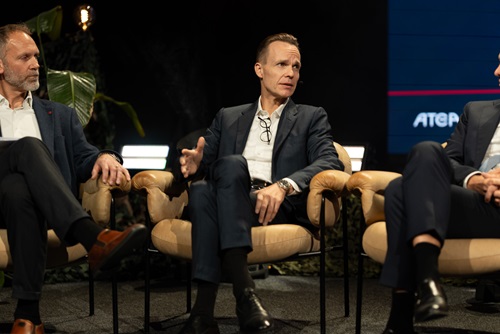
Both Norway's Minister of Defence, Tore O. Sandvik, and the heads of the Swedish, Danish and Norwegian Home Guards pointed to how quickly new technology is developed and put to use in Ukraine. The same theme shaped the main session "The Vacation Is Over", where Lars Alstrup, Nordic Head of Advisory Banking at Danske Bank, took part. He pointed to guarantees, working capital and predictable demand as three recurring challenges for defence suppliers across the Nordic region. According to Alstrup, the question is how quickly capital reaches the companies.
Why Danske Bank was there
Danske Bank was one of three main partners and also hosted its own side event on financing the Nordic defence scale-up. In an interview during the conference, Alstrup explains why the bank took part.
"Danske Bank wants to make sure that we play our role in creating a more secure and safe Nordic region," says Alstrup. "The increase in defence spending is also a major commercial opportunity for our customers. Defence spending in the Nordic region has tripled from 2014 up until today."
Danske Bank has supported the Nordic defence industry with financing and by investing customers' assets for many years. The bank is engaged with companies in the defence industry, including the majority of the major Nordic companies in the sector. It advises and helps secure financing for companies that already contribute to the industry, and for companies that may be able to do so in the long term.
This applies to companies seeking capital to expand production, customers wanting to enter the sector and defence-tech start-ups seeking advice. The work follows the bank's position statement on arms and defence, adjusted in March 2024.
"Nordic companies are well positioned. Nordic countries in general have low debt levels, healthy national budgets, we have stable political institutions, we have access to minerals and to a competitive energy mix. So there's no reason why Nordic countries shouldn't succeed even better at what we are doing."
Eirik Melle, Senior Analyst at Danske Bank

More than missiles and drones
Eirik Melle, Senior Analyst at Danske Bank, says the defence build-up reaches beyond the traditional defence industry.
"Defence is so much more than just missiles and drones. It's also about building the infrastructure, delivering the concrete, delivering the cables and also delivering the technological solutions that we both need for civilian use and also possibly defence use," says Melle.
According to Melle, the Nordic region has a strong starting point. "Fortunately, Nordic companies are well positioned. Nordic countries in general have low debt levels, healthy national budgets, we have stable political institutions, we have access to minerals and to a competitive energy mix. So there's no reason why Nordic countries shouldn't succeed even better at what we are doing."
More than a third are involved or considering it
Many Nordic companies already see opportunities in the defence market. In the survey Businesses in the Nordics 2026, conducted by Ipsos for Danske Bank, 38 per cent of Nordic executives say their company supplies the defence industry or is considering doing so.
In Norway the share is 36 per cent, close to the Nordic average. Six per cent supply the industry directly and 15 per cent supply dual-use products with both civilian and military applications. Sweden has the highest share at 42 per cent, driven by dual-use suppliers, while Denmark has the lowest at 35 per cent.
Norwegian companies stand out on what lies ahead. Fifteen per cent are considering becoming suppliers, the highest share in the region, and 28 per cent say they are not considering it, the lowest share of the four countries. At the same time, one in three Norwegian executives say the question is not relevant to their company, more than in any other Nordic country.
The survey was conducted among 825 executives in companies with annual revenue above EUR 4.5 million, around 200 in each Nordic country.
From budget to production
For Alstrup, the main takeaway from the conference was "the importance of creating speed". "Speed going from the national budgets into contracts, contracts into financing and financing into actual production," he says.
"We all need to play our role, but we need to play our role at a much higher pace."
Considering supplying the defence industry?
See analyses and webinars, and talk to our experts about financing, risk and opportunities in the defence sector.